


Best Carrier in San Francisco? It Depends Which Hill You Live On.
I spent nearly 20 years in the Bay Area before I moved to Los Angeles. I went to school at Stanford down in Palo Alto, then lived in San Francisco from 2009 to 2018. It's where I built a big chunk of my career, met my wife, and became a dad. So I have a soft spot for the city, and I also know its quirks. One of the biggest: your phone can work perfectly on one block and fall apart a few blocks away.
That might surprise people unfamiliar with the city since San Francisco is small. As SF residents well know, the city is famously 7 x 7 miles, roughly 47 square miles of land. You'd think a place that compact would get one consistent signal everywhere. It doesn't. San Francisco is packed with hills, and a carrier's network gets built site by site, hill by hill. Walk over one ridge and the whole picture can change.
So if you want to know how your phone will perform in the city by the bay, it's important to check coverage in the places you actually spend your time. And when you inevitably find yourself on the wrong side of a hill? Well, sometimes you just have to take your licks.
Why San Francisco Is Basically a Coverage Obstacle Course
So the root of the problem boils down to geography. San Francisco has more than 50 hills inside city limits, and most of them run together into ridges. Twin Peaks, Mount Sutro, and Mount Davidson sit near the middle of the city, with Mount Davidson topping out at about 925 feet. Add Nob Hill, Russian Hill, Telegraph Hill, Bernal Heights, and Potrero Hill, and you've got a city where line-of-sight to a cell site is never a safe assumption.
Here's a fun bit of San Francisco history I discovered: before Sutro Tower went up in 1973, TV reception across San Francisco was spotty because the hills kept blocking broadcast signals. The city's answer was a 977-foot, three-legged tower planted on one of its highest hills. Today that tower also hosts antennas for public safety, transportation, and even cellular signals. But cell networks can't solve the problem with one giant tower. They need hundreds of smaller sites, each one fighting its own hill.
And building those sites in San Francisco isn't easy. The city requires permits for wireless equipment on its poles and gives extra scrutiny in scenic and historic areas, a rule the California Supreme Court unanimously upheld. Neighborhood pushback is real too, as you'll see in Diamond Heights below. Slower buildout plus steep terrain equals patchy coverage.
It's also why naming one carrier the best across the entire country is tricky. Verizon, AT&T, and T-Mobile all have their strengths, but those strengths don't always translate from one city to the next. Goji has covered the bigger picture in our guide to which carrier has the best coverage, but San Francisco is a perfect example of why local geography matters so much.
Even the professional measurement firms can't agree on who "wins," which tells you something on its own. But with that said, let’s see Goji’s zoomed-out coverage view of San Francisco, and you can judge for yourself.
These maps give us a snapshot of how AT&T, T-Mobile, and Verizon compare across the city. They’re useful for spotting coverage differences, but they don't guarantee how your phone will perform at every address, especially indoors or during busy periods.
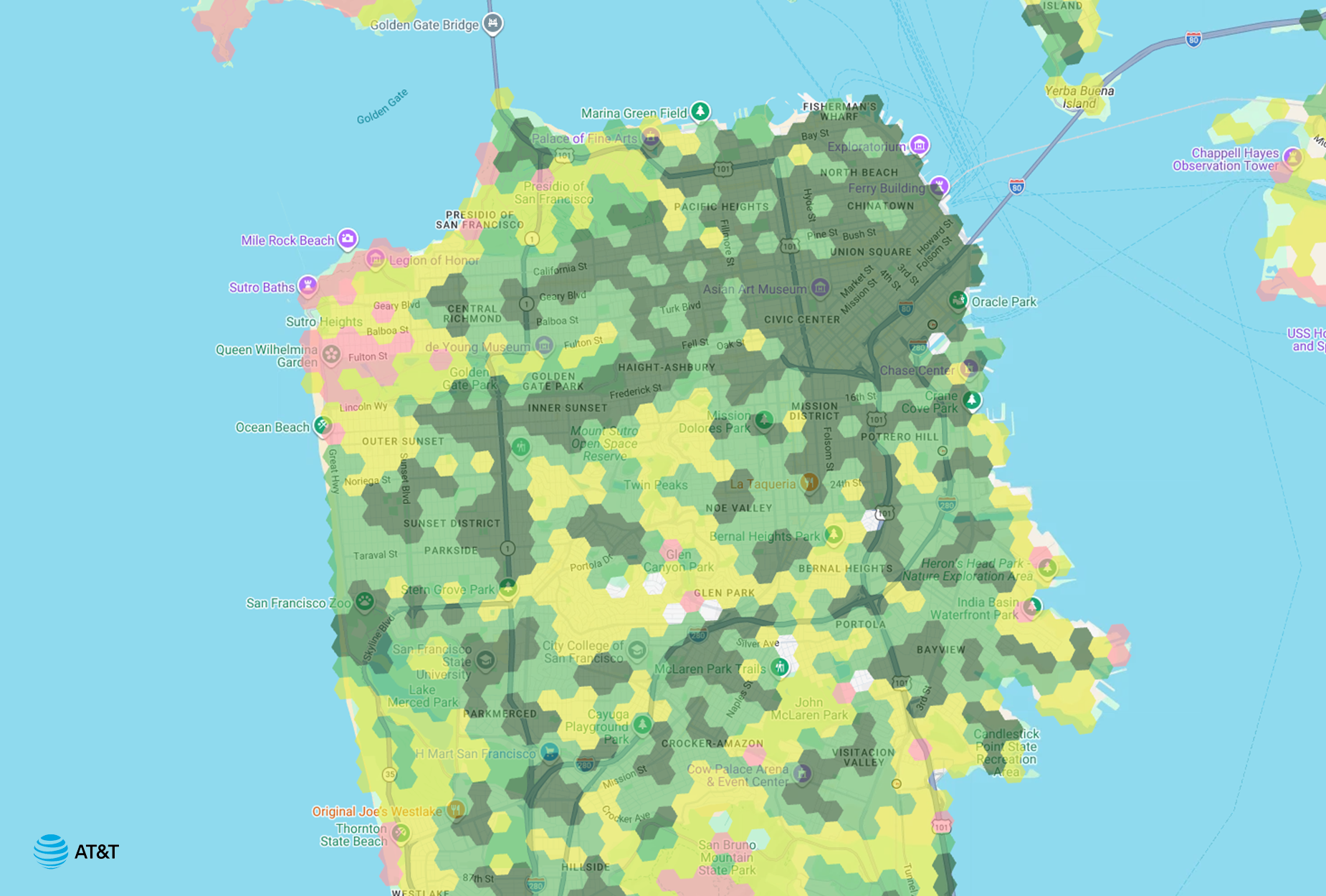
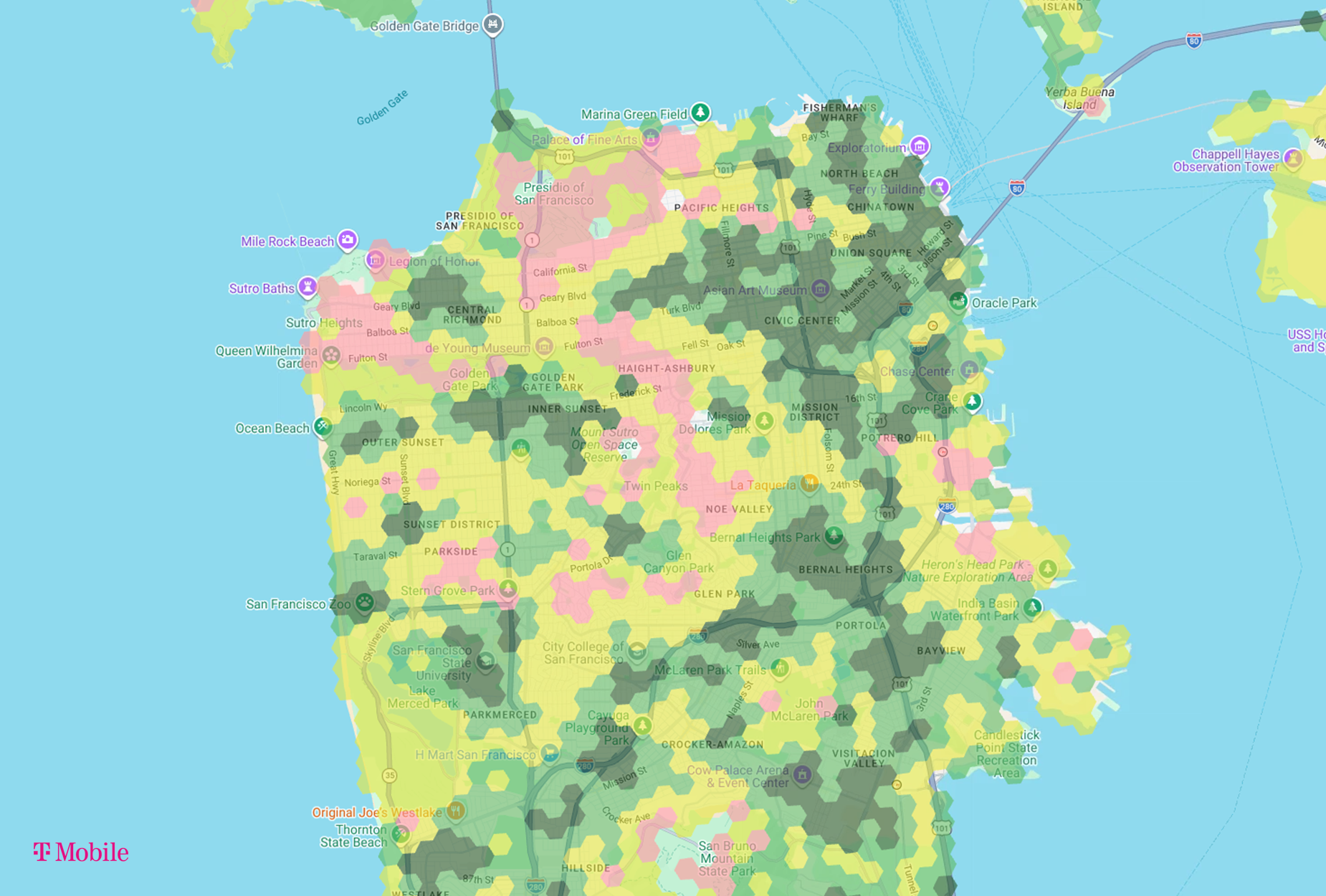
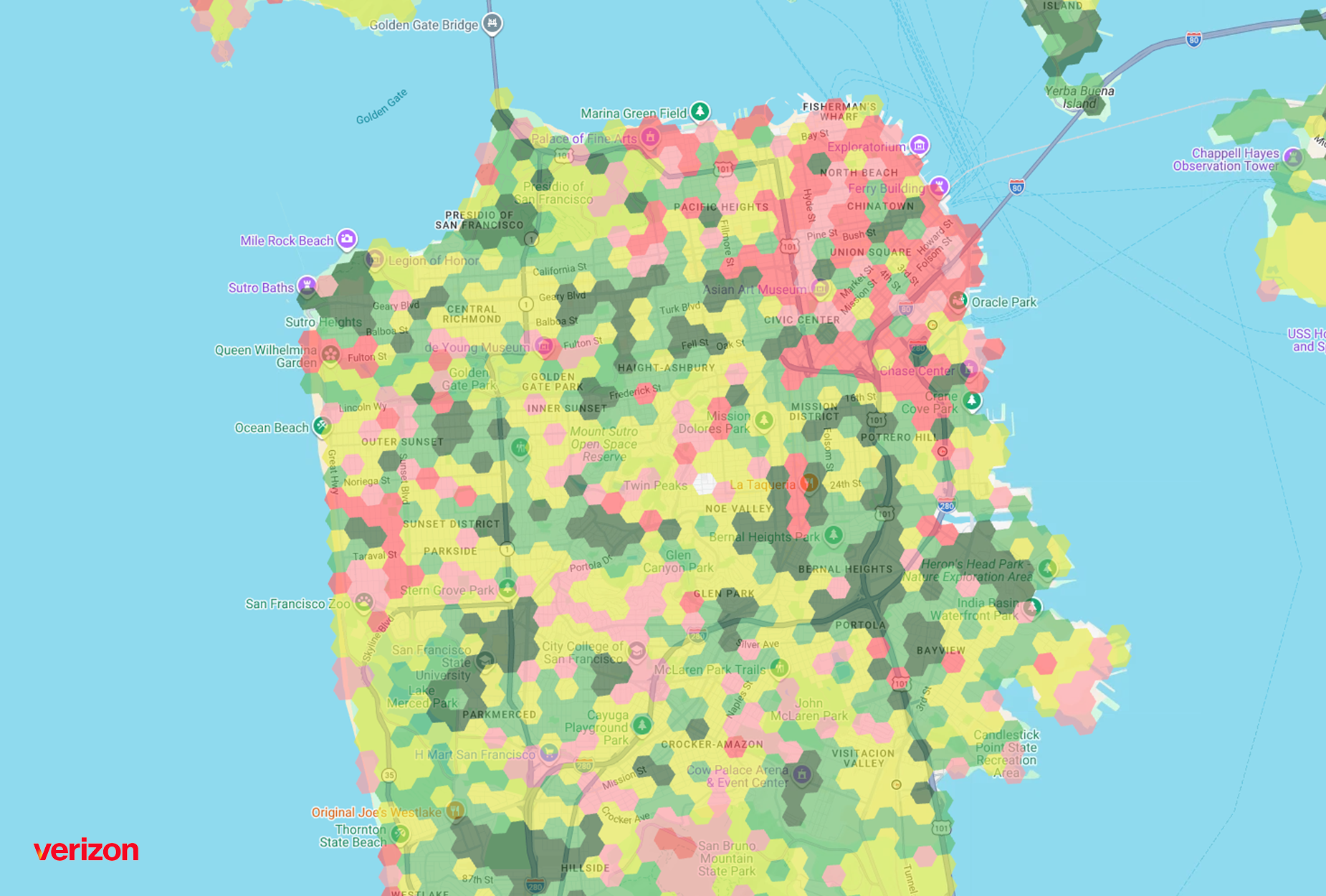
See anything? If you’re seeing what I’m seeing, then it looks like AT&T generally has the best coverage across all of San Francisco. But unless you're a rideshare driver crisscrossing the whole city – I worked at Lyft and even was a driver for a few rides, so trust me, I've heard the complaints – what really matters is coverage where you spend most of your day: at home and at work or school. So let's zoom in.
Twin Peaks and Diamond Heights: Great Views, Shaky Bars
The hills at the center of the city give you the best views in San Francisco. They also make life hard for cell networks. Homes in Twin Peaks, Diamond Heights, Midtown Terrace, and Forest Knolls are tucked onto steep, curving streets, and a phone sitting on the wrong side of a ridge can lose its clean line to a cell site.
The best evidence is the fight happening right now in Diamond Heights. This year the city approved a 104-foot AT&T macro tower in the heart of the neighborhood, next to the police academy and a playground. Residents pushed back hard on the looks and safety concerns. AT&T told the Board of Supervisors there was a significant need for it. Whatever you think of the tower, a carrier doesn't go through a fight like that for a neighborhood where coverage is already great.
If you're house-hunting up here, or just visiting the Twin Peaks overlook, check the address on a coverage map first. Don't assume that because your phone works fine in the Castro, it'll work the same way a mile up the hill.
Here's how Twin Peaks and Diamond Heights look on Goji's coverage map:


Just like the citywide view, AT&T looks strongest in Twin Peaks and Diamond Heights, and that's before its new Diamond Heights tower comes online.
The Other Usual Suspects
San Franciscans have complained about dead zones for a long time. In my research, I discovered that back in 2010, the San Francisco Business Times asked readers to report dead zones around the Bay Area and collected more than 500 of them in short order. TechCrunch noted that the vast majority were on one carrier, AT&T, which at the time was the only iPhone carrier. Networks have improved a lot since then, but the hillside penalty still shows up all over the city.
The Marina, Pac Heights, and North Beach
These are some of the most picturesque neighborhoods in the city, and they show how much coverage can change in a mile or two. Pacific Heights sits up on a ridge with sweeping views of the Bay. Walk down its steep blocks to the Marina, which is flat and built largely on landfill along the waterfront, and the line-of-sight picture to nearby cell sites changes completely. Head east and you hit North Beach, tucked between Telegraph Hill and Russian Hill, two of the city's original "Seven Hills," with narrow streets and older buildings packed tightly together.
These are also neighborhoods where new wireless equipment gets a close look. At one San Francisco Planning Commission hearing, a carrier's request to put six panel antennas on a light pole at the city-owned Marina parking garage on Pierce Street drew opposition from residents. That happened even though the city's own siting guidelines rated a public facility like that as a preferred location. That's San Francisco in a nutshell: even the "easy" sites come with a fight.
Here’s what the neighborhoods look like on Goji’s coverage map:


Once again, AT&T and T-Mobile hold up well here. But if you’re on Verizon and visiting Fisherman’s Wharf, don’t be surprised if your selfie with the Pier 39 sea lions takes forever to upload to Instagram.
Mission Bay and SoMa
This is my old neighborhood, and it's a very different story from the hills. Mission Bay is flat, newer, and dense with office buildings, labs, and condos. Big venues get their own in-building systems, too. Chase Center, which opened the year after I moved, was built with a distributed antenna system, including roughly 600 under-seat antennas, so 18,000 Warriors fans can post at the same time. But a strong signal inside the arena doesn't guarantee a strong signal in the condo across the street.
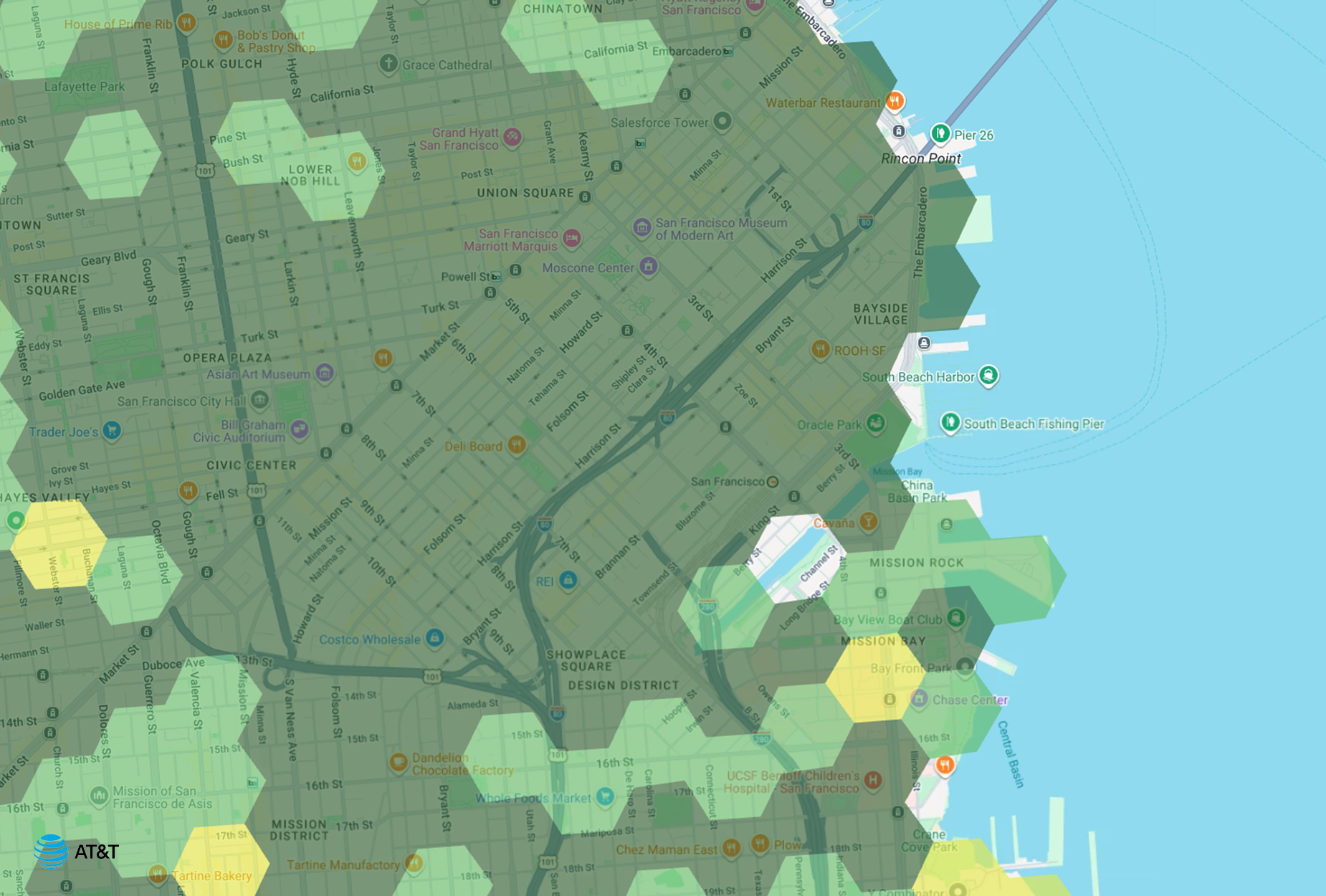

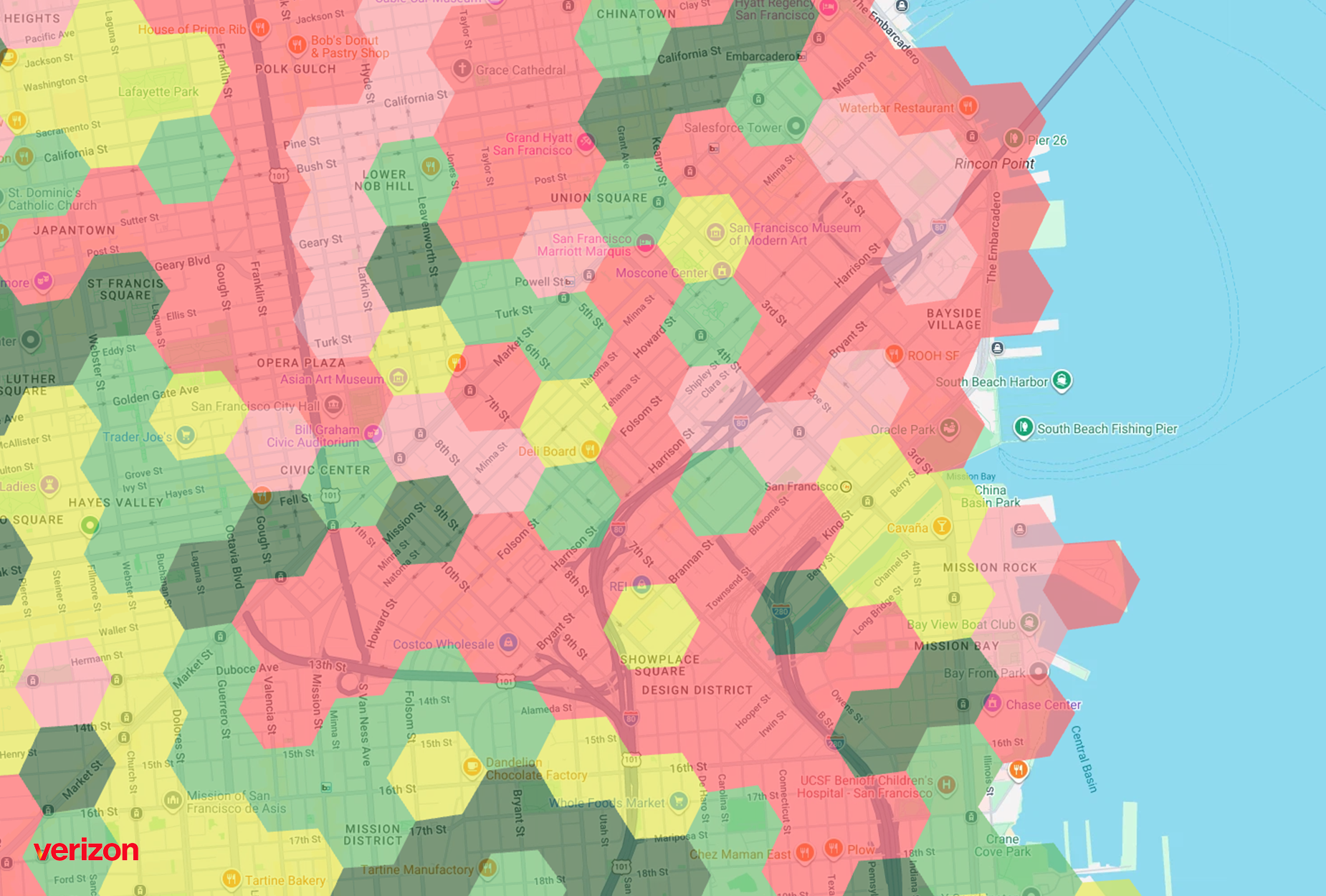
It’s a similar story to North Beach: AT&T and T-Mobile look strongest outdoors, while Verizon struggles. Heading to a Warriors game at Chase Center? The arena's built-in antenna system helps improve connectivity inside. But the walk there and the post-game crowd outside are a different story, and Goji's map suggests AT&T and T-Mobile have the edge in the surrounding neighborhood.
BART and the Peninsula commute
If you commute between the city and the Peninsula, you already know coverage isn't just about where you live. It also matters along the route you take every day. BART riders have complained about inconsistent cell service for years, including one Verizon customer who reported losing signal for much of the ride between downtown San Francisco and Millbrae. That's just one person's experience, and networks have changed since then, but it's a good reminder that coverage at home doesn't tell you much about coverage on your commute.
Further south, the fights over new sites get local fast. CBS reported on residents who fought a proposed Palo Alto cell tower near a Little League field with historically bad service. That's in the backyard of Stanford, in the heart of Silicon Valley. That same story cited an older RootMetrics ranking that put San Francisco 58th out of 125 metros for network performance. Not exactly what you'd expect from the tech capital of the world.
What This Looked Like From My Side of Town
For most of my years in the city, my home was in Mission Bay. I worked at Lyft, which was in the same neighborhood, so my commute was about as short as a San Francisco commute gets. I met my wife in San Francisco, and both of our kids were born at CPMC. My entire daily life fit inside a few flat blocks by the water.
I was a longtime Verizon customer back then, and in Mission Bay the network never gave me a reason to think twice. Home, office, the walk in between: it just worked. So when we moved to West LA in 2018, I assumed that reliability would follow me. It didn't. Verizon's signal at my new home and office was basically nonexistent, and I spent a lot of time walking outside just to finish a call. I wrote about that whole saga in my piece on Los Angeles coverage.
It ultimately pushed me to switch to T-Mobile, and it's why I put my daughter on Mint Mobile's kids plan, since Mint runs on T-Mobile's network. Same carrier, same phone, different address, completely different experience. Looking back, I wasn't loyal to Verizon because Verizon was best everywhere. I was loyal because it happened to be great in the few blocks where I lived and worked. Funny enough, today's Goji map shows Verizon struggling in my old Mission Bay neighborhood. Networks change over time, which is one more reason to check current coverage instead of relying on what worked for you years ago.
The Real Takeaway: Check Your Actual Address
In the neighborhoods I checked, AT&T came out ahead most often, with T-Mobile close behind. But that doesn't make any carrier "good in San Francisco" or "bad in San Francisco." The city packs a lot of hills, ridges, and permitting hurdles into just 47 square miles. A citywide average tells you almost nothing about what will happen on your street.
And this isn't just a San Francisco problem. Even when you look at which carrier has the best coverage in California, the answer changes depending on where you are. A network that performs well across the state might still struggle on your particular block.
That's exactly why we built Goji's coverage map around addresses instead of city-level claims. Drop in your apartment in the Inner Sunset, your office in SoMa, or that rental on Russian Hill, and see how each carrier's signal strength and real-world call, text, and streaming performance actually looks there. If you're moving to San Francisco, apartment-hunting in the hills, or tired of losing signal on the same stretch of your commute, check the address before you assume your current carrier will follow you. In a city this hilly, "good coverage in San Francisco" isn't a real category. Good coverage in the places you actually live, work, and spend your time is what really matters.
Frequently Asked Questions
Which cell phone carrier has the best coverage in San Francisco?
Based on Goji's coverage maps, AT&T generally has the strongest coverage across San Francisco, with T-Mobile close behind. However, coverage varies significantly by neighborhood, so the best carrier for you depends on where you live, work, and spend your time.
Is AT&T or Verizon better in San Francisco?
AT&T appears to have better overall coverage than Verizon in the San Francisco neighborhoods examined in this article, including Twin Peaks, Diamond Heights, and Mission Bay. However, Verizon may still perform well at specific addresses, so it's worth comparing coverage before switching.
Why is cell phone coverage so bad in parts of San Francisco?
San Francisco's steep hills, dense buildings, and restrictions on wireless infrastructure can make consistent cell coverage challenging. Neighborhoods separated by just a few blocks may experience different signal strengths depending on nearby cell towers and terrain.
How can I check cell phone coverage at my address in San Francisco?
You can use Goji's free coverage map to compare AT&T, Verizon, and T-Mobile coverage at a specific address. Checking your home, workplace, and other frequently visited locations can help you choose a carrier that fits your needs.