


I live on the west side of Los Angeles, and my phone works great … most of the time. I get fast, reliable service around Santa Monica, Venice, and Culver City without thinking about it. Then I'll drive to Monterey Park for some legit Chinese food, and suddenly I'm holding my phone up to the window like it's 2003. Same phone, same carrier, same city. Wildly different result.
That's the thing about cell phone coverage in Los Angeles that a lot of "which carrier is best in LA" articles get wrong: they treat the city like it's one market. It isn't. LA County sprawls across roughly 4,000 square miles of coastline, basin, hillside, canyon, and mountain, and a carrier's network doesn't get applied evenly across all of it. It gets built tower by tower, hill by hill, and one canyon over from you, the whole picture can change.
So if you're trying to find the best cell phone coverage in Los Angeles, the answer isn't as simple as picking AT&T, T-Mobile, or Verizon. "Coverage in Los Angeles" isn't really the question. "Coverage on my block" is.
Which Carrier Has the Best Cell Phone Coverage in Los Angeles?
There isn't one carrier with the best cell phone coverage everywhere in Los Angeles. T-Mobile shows stronger coverage across many of the areas we looked at, but AT&T and Verizon can perform better in specific neighborhoods. In LA, the best carrier really comes down to where you live, work, and spend most of your time.
That's why comparing coverage at your actual address is much more useful than looking at which carrier has the best coverage across Los Angeles as a whole.
If you want to understand why your signal can change so much from one neighborhood to the next, our guide to which carrier has the best coverage breaks down what affects cell service and how the major networks compare.
Why Cell Phone Coverage Varies So Much Across Los Angeles
The root of the problem is geography. The Santa Monica Mountains cut directly through the middle of the city, running about 40 miles from the Hollywood Hills out to Point Mugu, forming a physical wall between the San Fernando Valley and the LA Basin. Add in Griffith Park, the Baldwin Hills, the Verdugo Mountains, and the bluffs along the coast, and you've got a city where line-of-sight to a cell tower is never a safe assumption.
I found an interesting geographic analysis of T-Mobile's Los Angeles County tower network coverage and the TLDR is that T-Mobile’s sites cover only about 42.8% of the county's land area, with the weakest coverage concentrated in the mountainous terrain ringing the city, which is the same hillside neighborhoods a lot of Angelenos actually live in. That's not a knock on T-Mobile specifically because every carrier fights the same terrain. It's just a clear illustration of how much of LA's landmass is genuinely hard to serve. Note: I’m on the T-Mobile network myself. More about that later.
Even the professional measurement firms disagree with each other on who "wins" in LA, which tells you something on its own. RootMetrics' most recent Los Angeles report named AT&T and Verizon co-winners for overall performance, while T-Mobile posted the fastest median download speeds in the market. Other independent coverage analyses tell a similar story, showing AT&T, T-Mobile, and Verizon all landing within a few points of each other on raw 4G/5G footprint across the city.
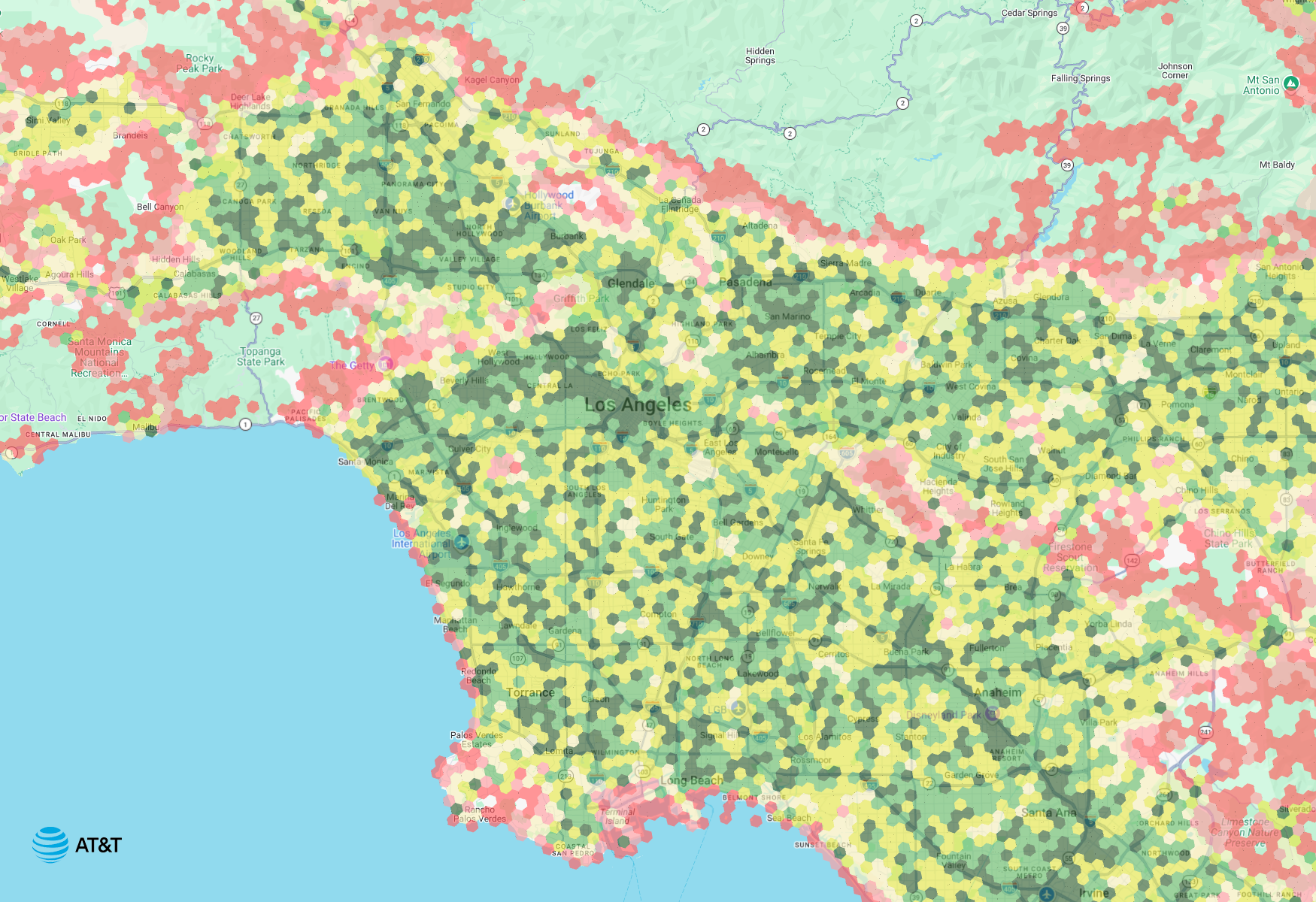
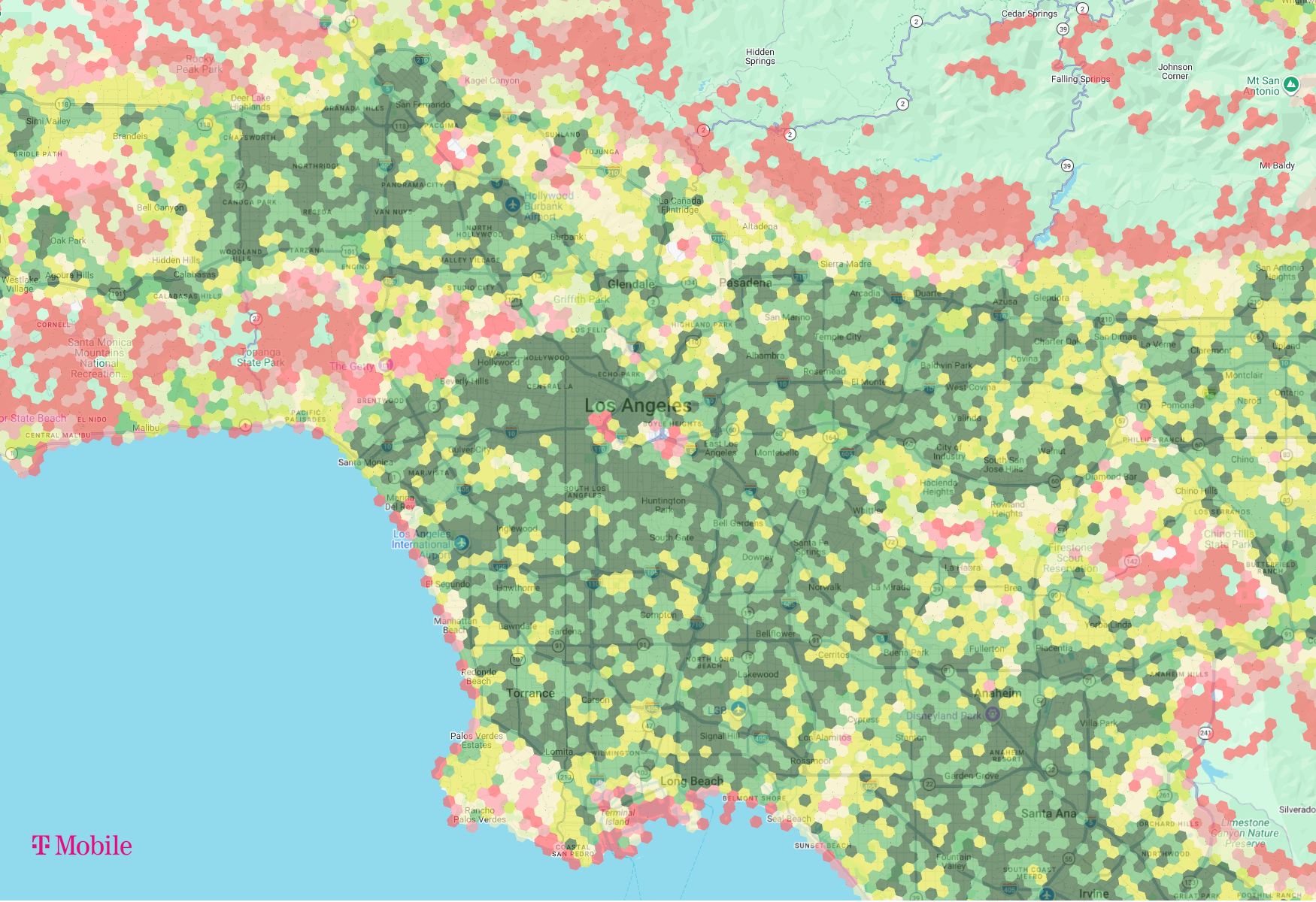
Here’s Goji’s coverage data for AT&T, T-Mobile, and Verizon. Do you see what I’m seeing?
AT&T’s coverage of Los Angeles
T-Mobile’s coverage of Los Angeles
Verizon’s coverage of Los Angeles
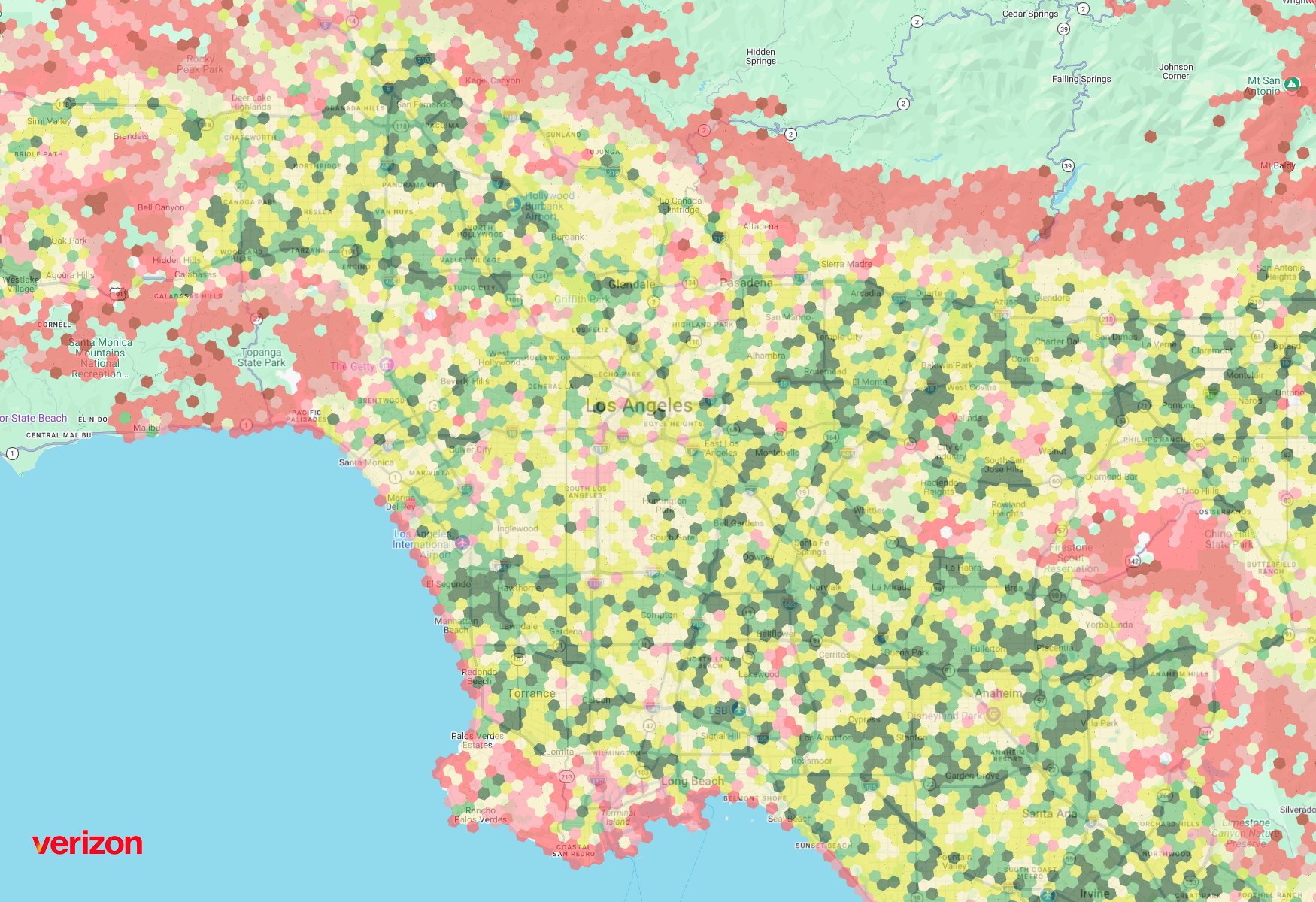
Yes, you're probably seeing the same thing I am: T-Mobile's the clear winner here. But unless you're a rideshare driver crisscrossing all of Los Angeles, what really matters is coverage where you probably spend nearly 80% of your day, which is at home and work (or school).
But let’s zoom in a little bit, as you’ve probably guessed what the point of this post is about: coverage matters where you live.
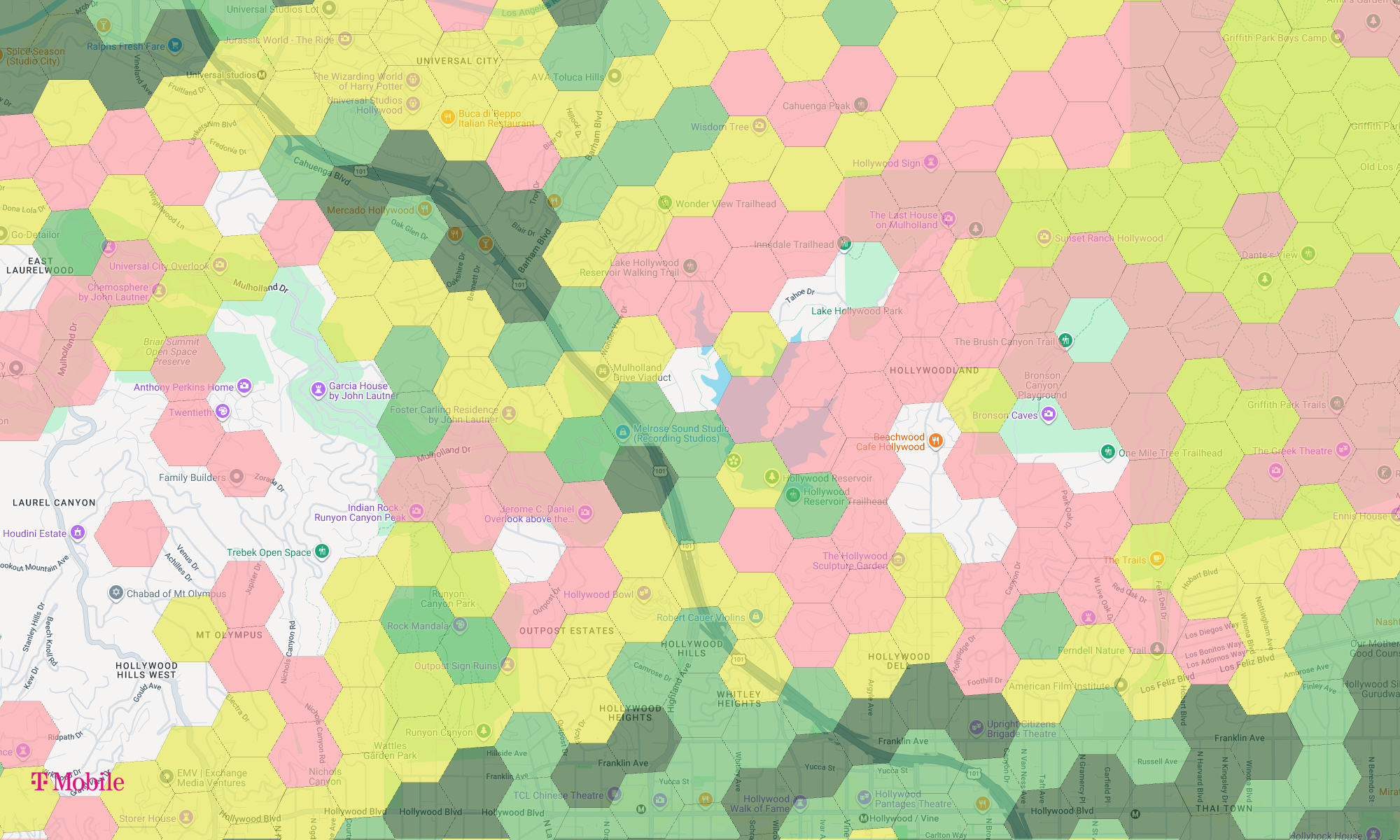
Cell Phone Coverage in the Hollywood Hills
I'd heard the "Hollywood Hills has terrible reception" line for years and wanted to actually check it for myself. So I drove over there, stopping by my favorite Mexican restaurant, El Compadre – yes I know us Angelenos are very opinionated and passionate about our Mexican food, and there’s lots more restaurants and food trucks I need to try – and used the Goji app to run a speed test. And yup, it holds up like traffic on the 10 near downtown.
This isn't a new complaint or a rumor that got out of hand on Reddit. The LA Times was writing about it back in 2008, quoting deadcellzones.com, which specifically named the Hollywood Hills, alongside Malibu and Palos Verdes, as one of the areas Southern Californians complained about most. Almost two decades later, the complaints haven't gone anywhere. On this Reddit thread specifically about the best carrier for the Hollywood Hills, residents reported that "Sprint, Verizon, AT&T, and T-Mobile all do very poorly," with one person noting that near the top of a hill by Griffith Park, "cell phones are basically worthless". A separate Reddit thread cataloging dead zones across the city called out Whitley Heights specifically as a Verizon dead zone, and just wrote off "all of the Hollywood Hills" as a lost cause.
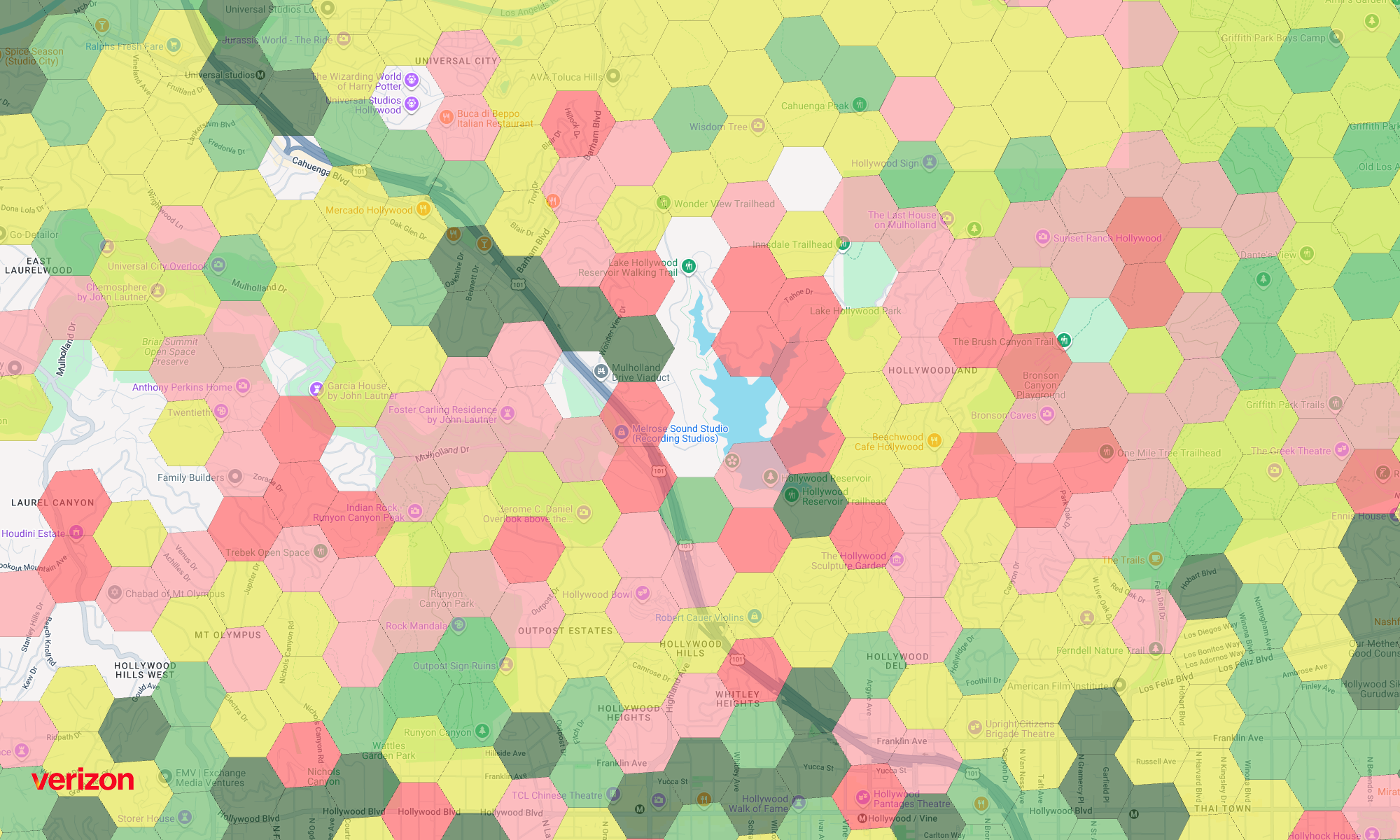
The reason is straightforward once you think about it: it's steep, winding terrain with homes tucked into canyons, and cell sites can't always get a clean line of sight to a phone sitting behind a ridge. If you're house-hunting or just visiting up there, do yourself a favor and check the address on a coverage map first. Don't assume that because your phone works fine in Silver Lake or Los Feliz, it'll work the same three miles up Beachwood Canyon.
Here’s how the Hollywood Hills coverage looks visually with Goji’s coverage map:
AT&T’s coverage of the Hollywood Hills

T-Mobile’s coverage of the Hollywood Hills
Verizon’s coverage of the Hollywood Hills
Los Angeles Neighborhoods Where Cell Coverage Can Vary
Once you start looking, the "hillside penalty" shows up all over the city, and it's not limited to Hollywood:
Cell Phone Coverage in Malibu and the Canyons
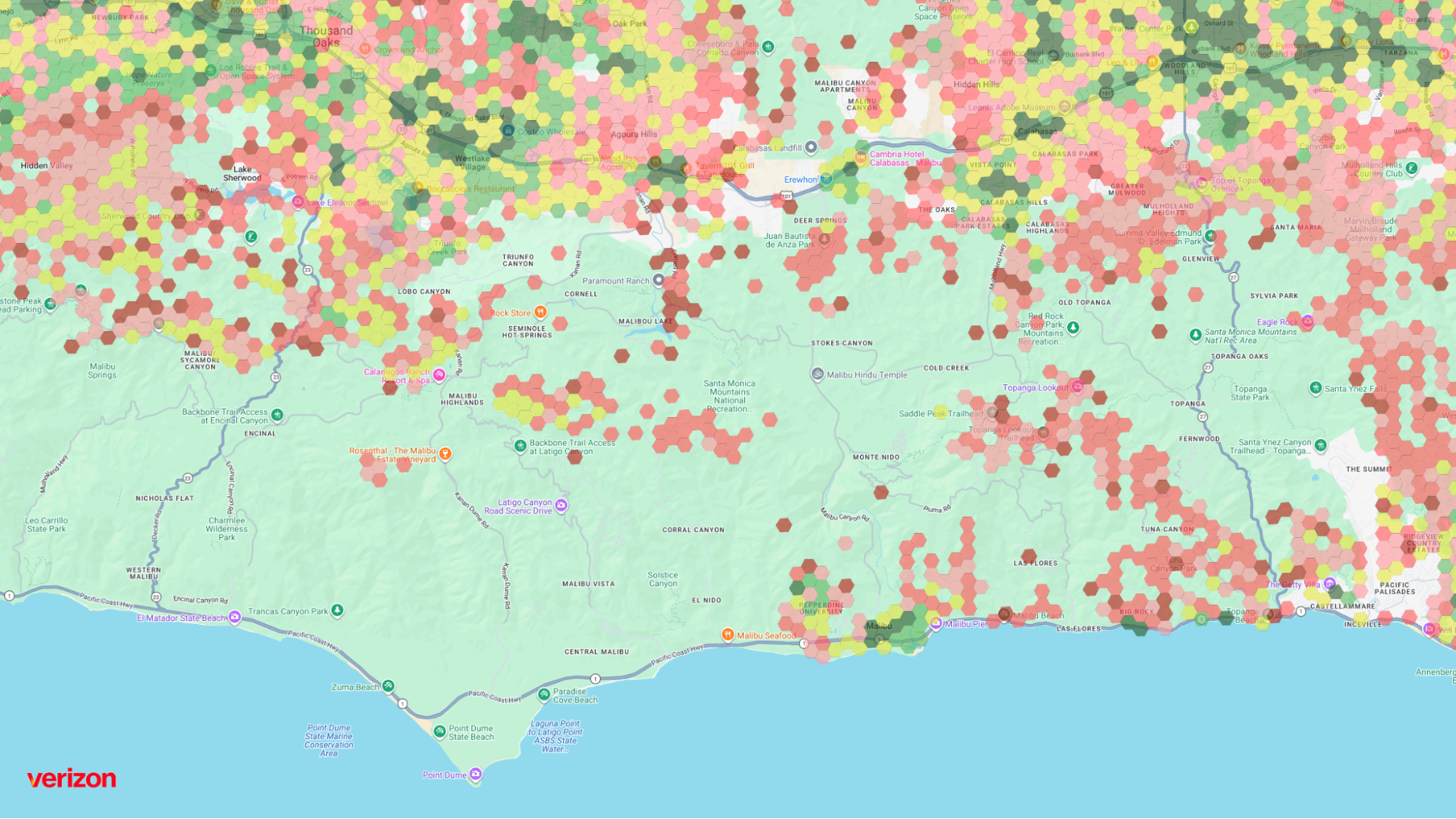
The Santa Monica Mountains don't stop at Hollywood. They run all the way out past Malibu, and coverage out there has always been thin, especially off Pacific Coast Highway and up Malibu Canyon, Kanan Dume, and Topanga Canyon roads. It got worse, not better, after the recent wildfires. Verizon's own network status page documented fiber damage and "spotty coverage" along PCH and the canyon commuter routes as crews worked to restore microcell sites, a reminder that hillside networks in fire country are genuinely more fragile.
AT&T’s coverage of Malibu Canyon

T-Mobile’s coverage of Malibu Canyon

Verizon’s coverage of Malibu Canyon
Cell Phone Coverage in Silver Lake and Los Feliz
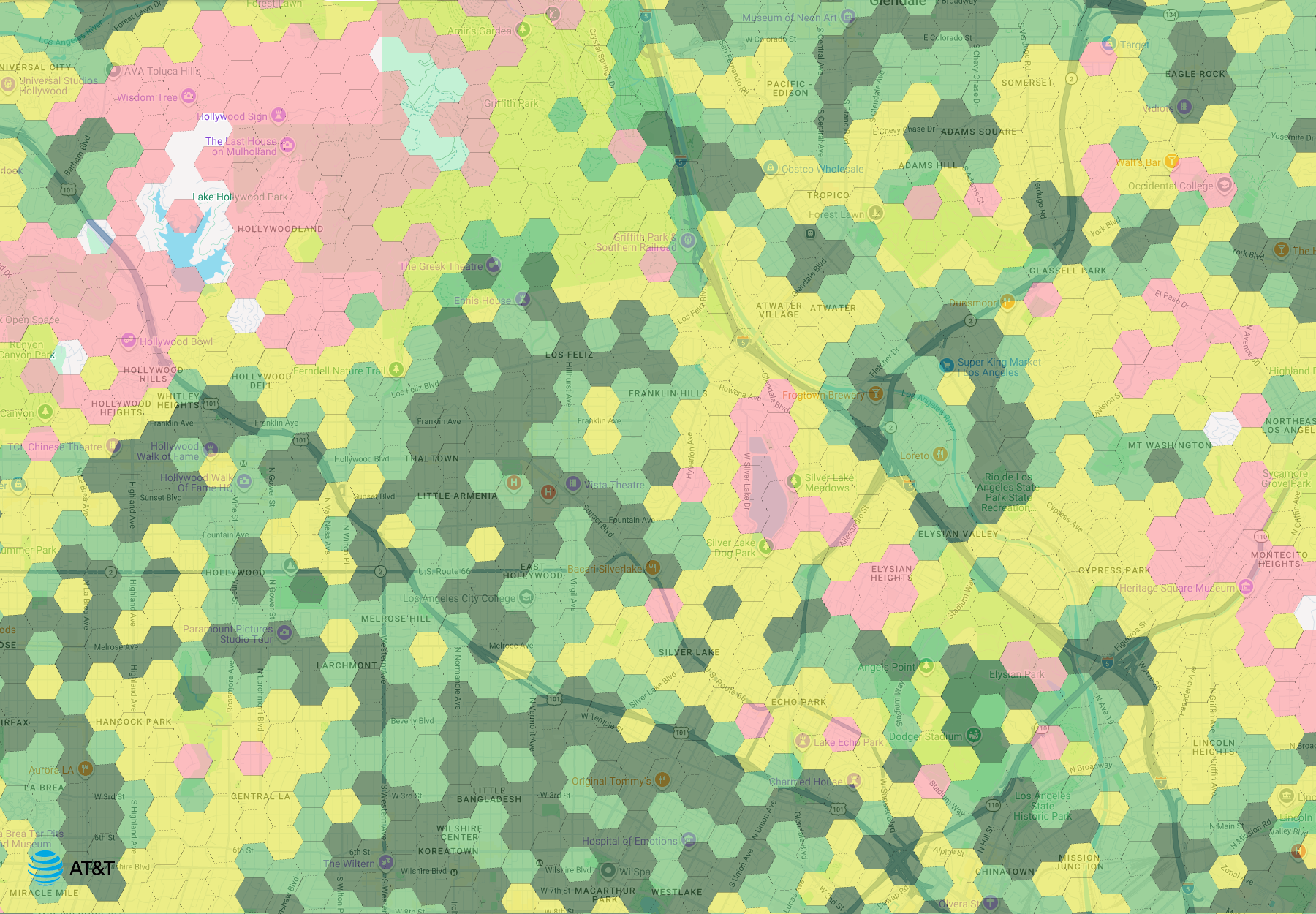
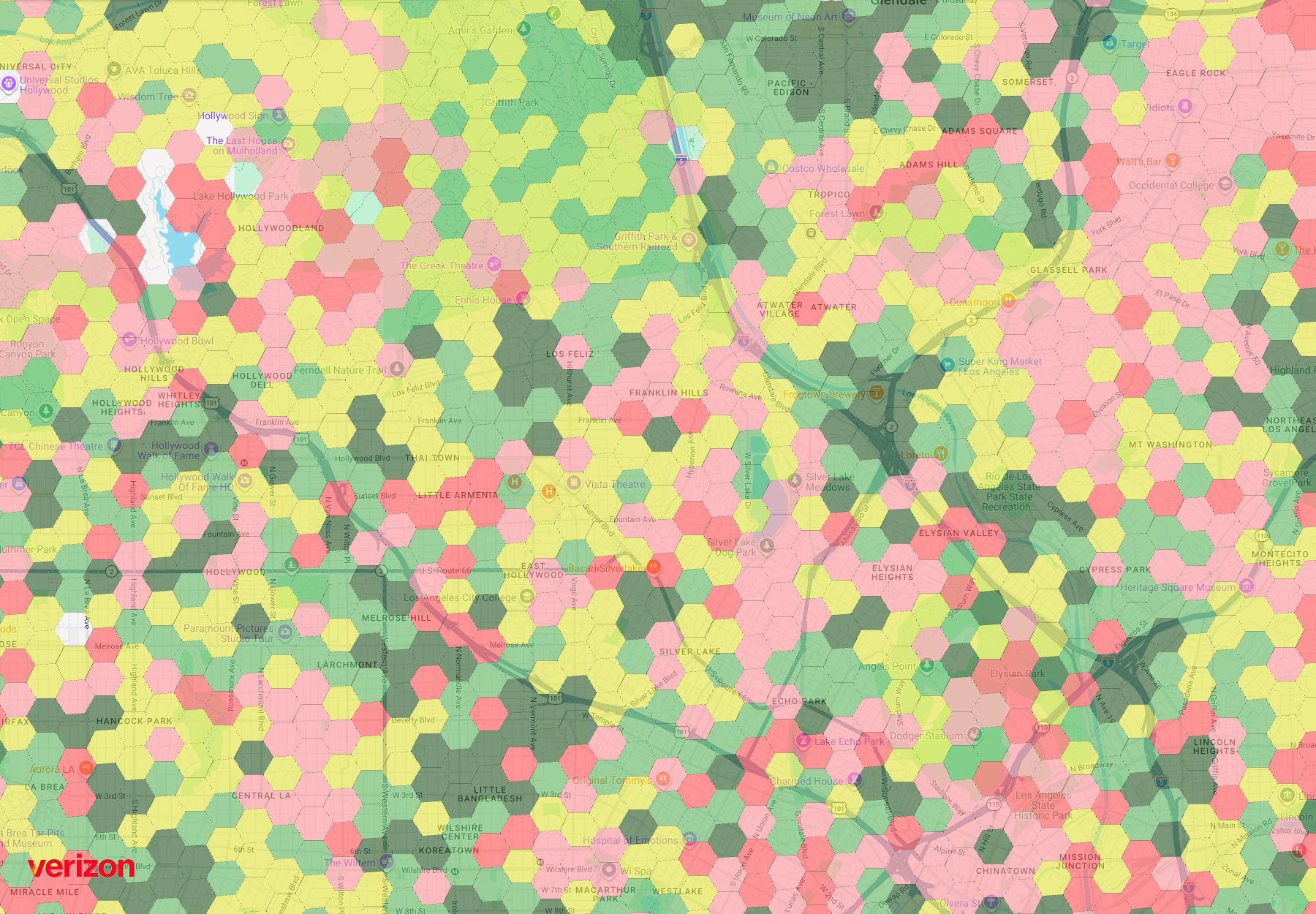
Same story, smaller hills. Redditors specifically flag AT&T as weak once you're up in the hills, and call the Rowena corridor a near-universal dead spot. Bad enough that local businesses advertise Wi-Fi specifically because cell service can't be counted on.
AT&T’s coverage of Silver Lake and Los Feliz
T-Mobile’s coverage of Silver Lake and Los Feliz

Verizon’s coverage of Silver Lake and Los Feliz
Cell Phone Coverage in Downtown Los Angeles
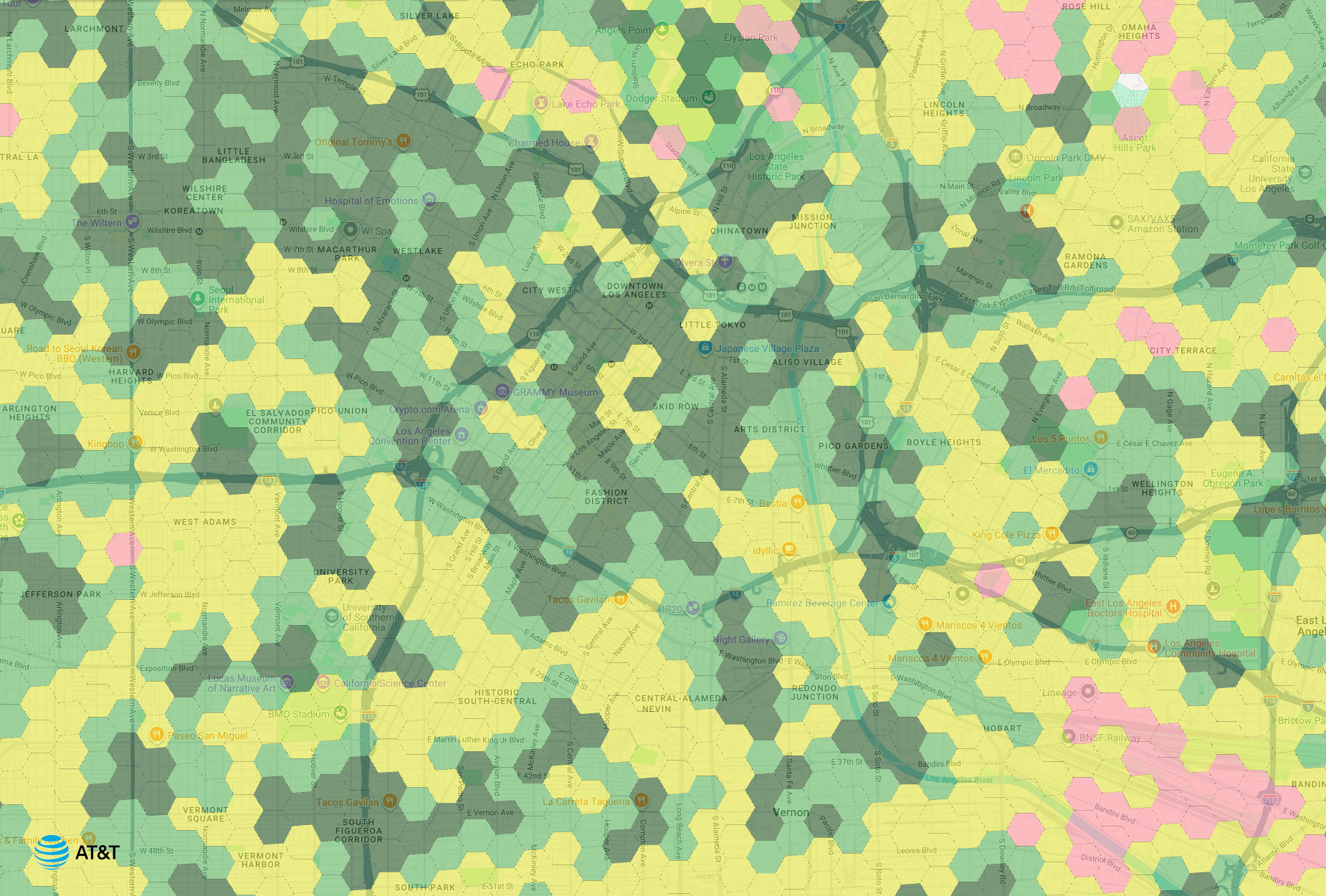
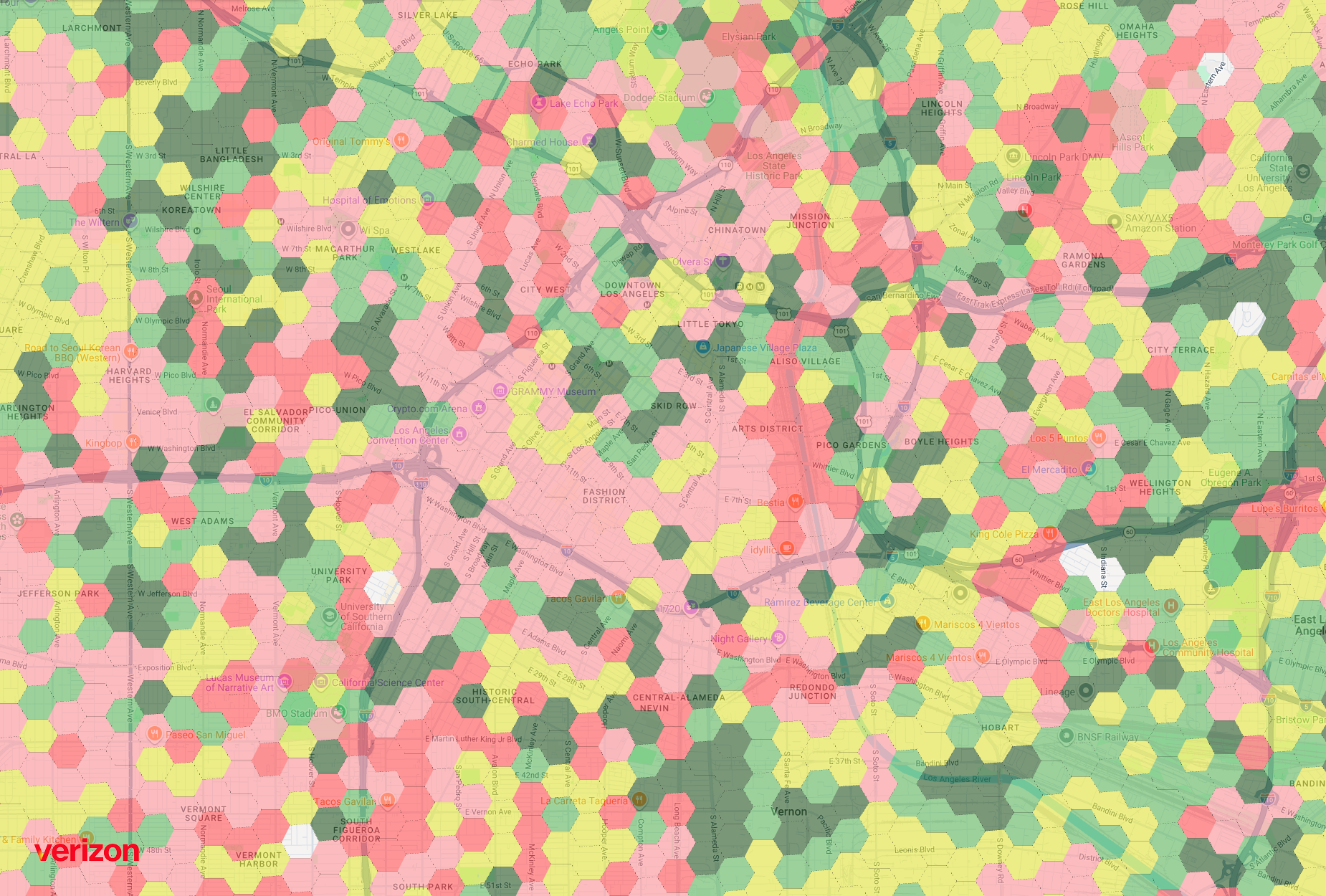
I pulled up the coverage maps for Skid Row, the Fashion District, Arts District, and the stretch of the 110/101 interchange that everyone loves to hate, and the differences are hard to miss.
T-Mobile blankets almost the entire area in solid green, with only a few yellow patches creeping in near the edges toward Lincoln Heights and Boyle Heights. AT&T is serviceable but inconsistent: mostly yellow, meaning decent-but-not-great coverage, with pockets of dark green and the occasional pink dead zone scattered throughout, including right around the Convention Center and Crypto.com Arena. Verizon is the one that struggles the most: big swaths of pink and red wash over Pico-Union, the Fashion District, and Skid Row, with only scattered pockets of green holding up.
If you work downtown, catch shows at Crypto.com Arena, or grab lunch in the Arts District, that's the kind of detail worth checking before you assume your carrier's got you covered just because it works fine at home in the Valley or the Westside.
AT&T’s coverage of Downtown LA
T-Mobile’s coverage of Downtown LA

Verizon’s coverage of Downtown LA
Cell Phone Coverage in Koreatown and Miracle Mile
Koreatown tells the same story. T-Mobile blankets the neighborhood in green, with only a few yellow patches near Larchmont breaking it up. AT&T is more of a checkerboard: decent yellow and green coverage, but with a couple of pink dead zones near Larchmont Boulevard. Verizon struggles most, with pink and red patches spreading through Central LA, Wilshire Center, and Harvard Heights, including right around Koreatown Plaza and the Wiltern.
AT&T’s coverage of Koreatown

T-Mobile’s coverage of Koreatown
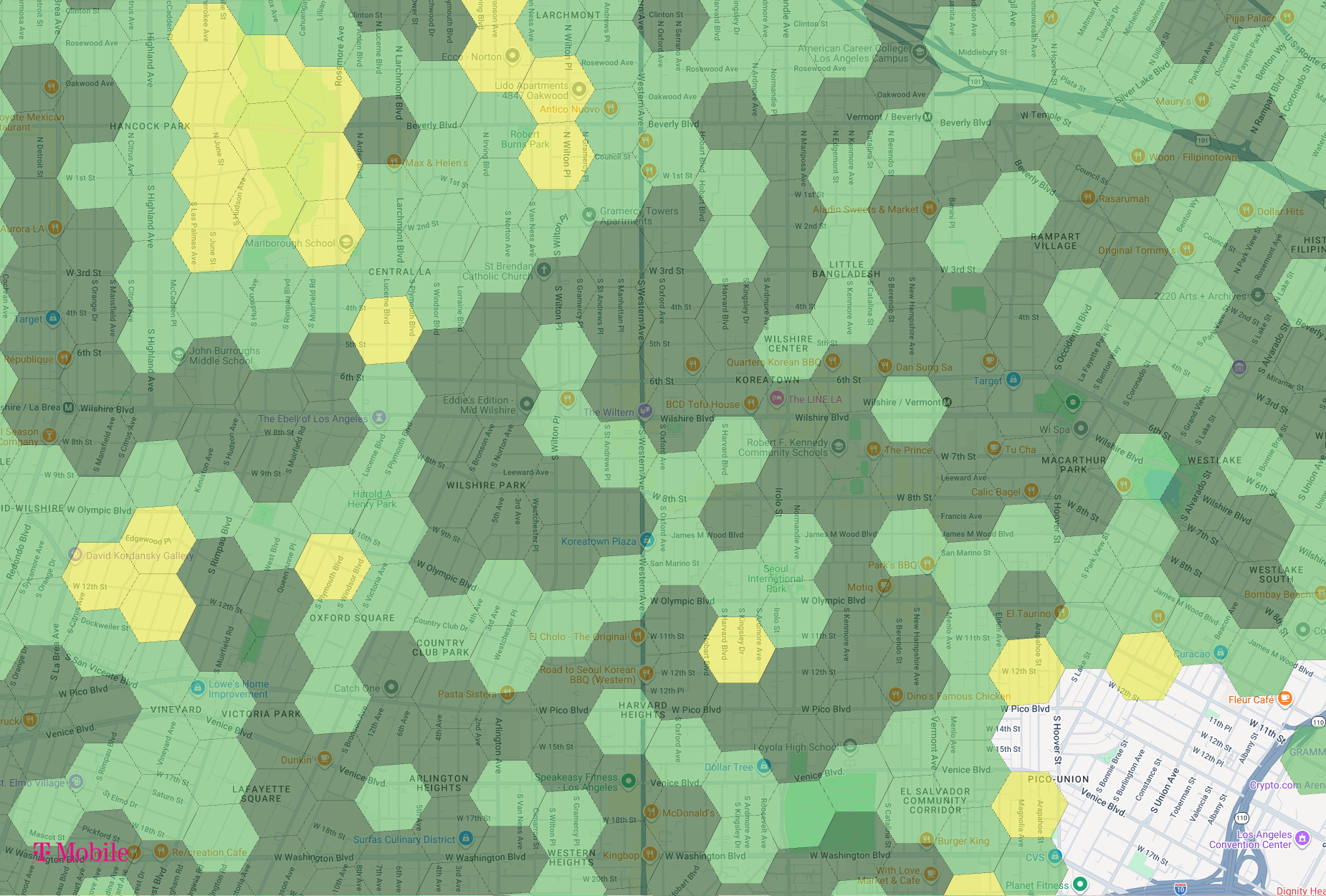
Verizon’s coverage of Koreatown

Which Carrier Has the Best Coverage in West Los Angeles?
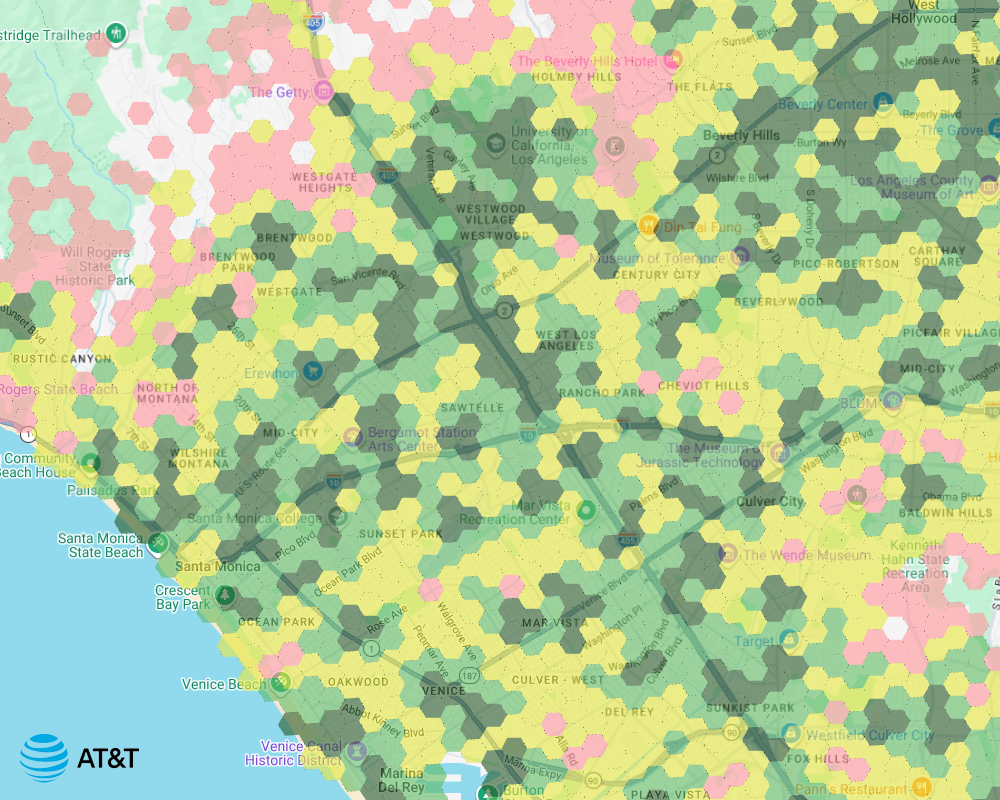
I learned this lesson the hard way moving to West LA. I was a longtime Verizon customer up in San Francisco, where the network never gave me a reason to think twice about it. When I moved from SF to LA and started working out of West LA, I assumed that reliability would just carry over. It didn't. Verizon's signal at my home and work was basically non-existent, and I found myself constantly walking outside my house to try to get better cellular reception.
Check out these Goji coverage maps, and you can visually see the coverage quality differences between the three major carriers.
AT&T’s coverage of West LA
T-Mobile’s coverage of West LA
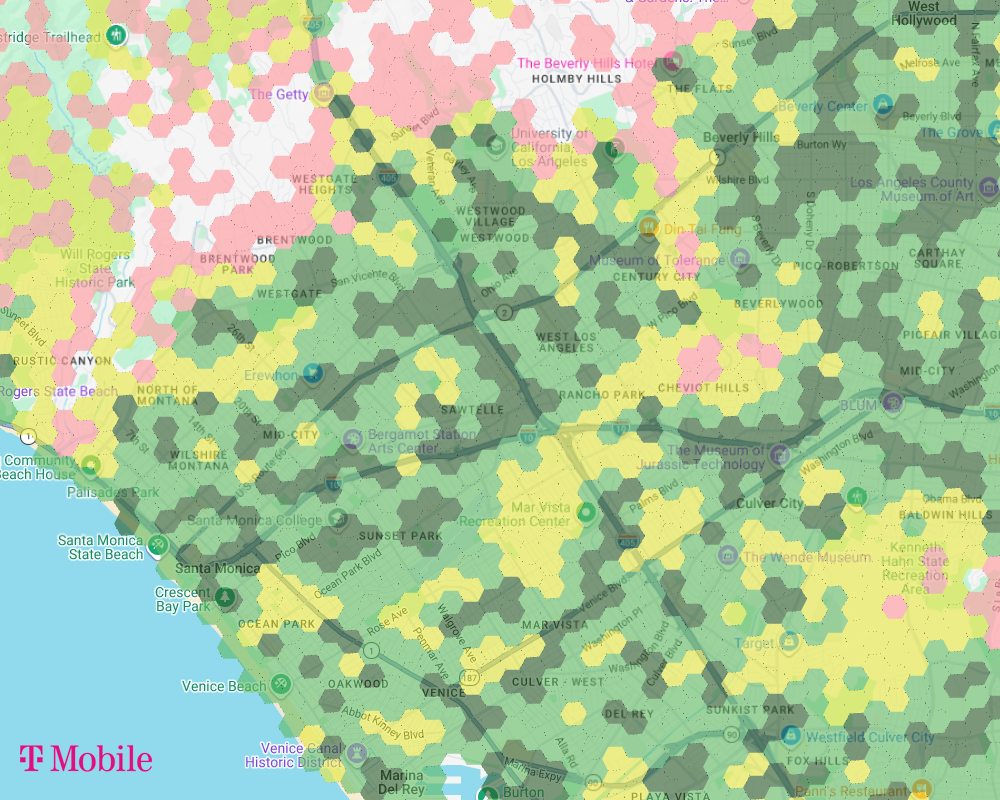
Verizon's coverage of West LA
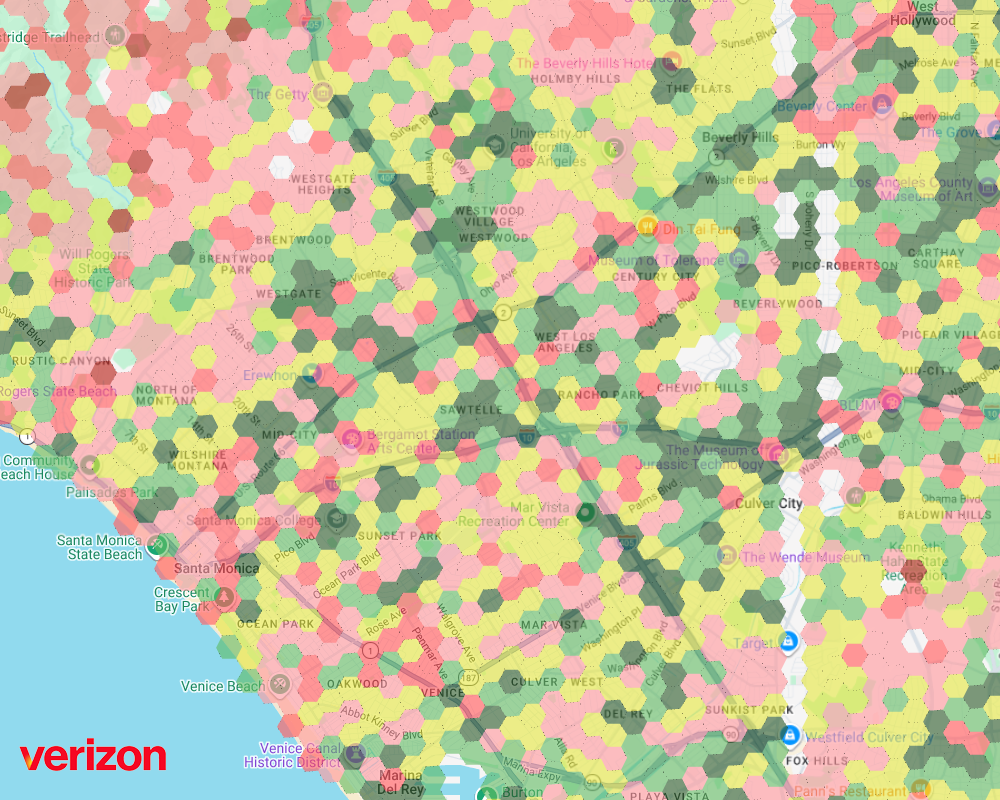
Verizon’s poor coverage in my area ultimately pushed me to switch to T-Mobile, and it’s also why I put my daughter onto Mint Mobile’s kids plan, since Mint Mobile runs on T-Mobile’s network.
The Real Takeaway: Check Your Actual Address
None of this means any single carrier is "bad in LA" or "good in LA." It means LA is topographically one of the most complicated cities in the country to build a mobile network across, and a citywide average tells you almost nothing about what will happen at your specific address, on your specific street, in your specific canyon.
That's exactly why we built Goji's coverage map around addresses instead of city-level claims. You can drop in your home, your office, or that Airbnb up in Laurel Canyon and see how each carrier's signal strength and real-world call, text, and streaming performance actually looks there, rather than trusting a marketing map that colors the whole metro area the same shade of green.
If you're moving to LA, house-hunting in the hills, or just tired of losing signal on the same stretch of road every week, check the address before you assume your current carrier will follow you there. In a city this sprawling, "good coverage in LA" isn't a real category. Good coverage in the places you actually live, work, and spend your time is what really matters.
Frequently Asked Questions
Which carrier has the best cell phone coverage in Los Angeles?
There isn't one carrier that's best everywhere in Los Angeles. T-Mobile shows strong coverage across many of the areas we looked at, but AT&T and Verizon may perform better in specific neighborhoods, so it's worth checking coverage at your actual address.
Does T-Mobile have good coverage in Los Angeles?
T-Mobile has strong coverage across much of Los Angeles based on the coverage areas we examined. However, hills, canyons, buildings, and your exact location can all affect the signal you actually get.
Does Verizon have good coverage in Los Angeles?
Verizon coverage varies significantly depending on where you are in Los Angeles. Some areas have strong service, while the coverage maps we examined show weaker spots in neighborhoods including parts of Downtown LA, Koreatown, and West LA.
Why is cell service bad in the Hollywood Hills?
The steep hills, canyons, and ridgelines around the Hollywood Hills can make it difficult for cell sites to maintain a clear signal. That's why coverage can change significantly even between nearby streets or neighborhoods.
How can I check cell phone coverage at my address in Los Angeles?
You can use Goji's coverage map to compare AT&T, T-Mobile, and Verizon coverage at a specific address. Checking the places where you actually live and work gives you a better idea of which network may work best for you than looking at Los Angeles as a whole.